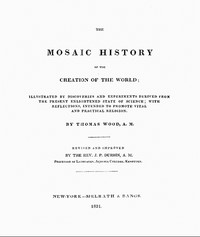
The Mosaic History of the Creation of the World by Thomas Wood
Published in 1820, Thomas Wood's book is a detailed defense of the Genesis creation story. He sets out to prove that the biblical account is not only true but also perfectly compatible with the emerging science of his day, particularly geology. Wood walks readers through the traditional six days of creation, but he doesn't stop there. He brings in rock formations, fossil records, and the structure of the Earth itself as evidence. For Wood, every layer of stone and every ancient bone was a piece of a divine puzzle, placed there to confirm the truth of scripture.
Why You Should Read It
Don't pick this up expecting a modern science book. The real value is in the human story. Wood writes with a genuine urgency. You can feel his need to make everything fit together in a world that was starting to question old certainties. He's not a closed-minded fanatic; he's engaging with the new ideas, trying to absorb them into his worldview. Reading it today, it's less about whether his conclusions were right and more about witnessing a particular kind of intellectual struggle. It shows us how people process huge, unsettling changes in how they see the universe. His arguments, which might seem strained now, were a serious effort to build a bridge between faith and reason.
Final Verdict
This book is a hidden gem for a specific reader. It's perfect for anyone interested in the history of science and religion, especially the early 19th century. If you enjoy seeing how cultural debates played out in the past, or if you're fascinated by books that capture a specific moment in intellectual history, you'll find Wood's work compelling. It's not a light read—the language is of its time—but it offers a raw, unfiltered look at a conversation that was just beginning and is still very much alive. Approach it not as a source of answers, but as a remarkable artifact of a man trying to find them.
No rights are reserved for this publication. Use this text in your own projects freely.